Al Scates speaks to the commitment to practice and willingness to try new approaches. When you hit a brick wall, sometimes you have to back up a step and look for a loose brick.
Volleyball is not just a sport but a way of life. Since its conception in the late 1800s at Holyoke, Massachusetts, USA by a YMCA physical education director, William G. Morgan, the game has gained popularity over the word and is now considered as among the most popular team sport.
This is the first post on my new blog. I’m just getting this new blog going, so stay tuned for more. Subscribe below to get notified when I post new updates.
Volleyball is one of the most successful and popular competitive and recreational sports in the world. It is played by two teams on a playing court divided by a net. The objective of the game is to send the ball over the net in order to ground it on the opponent’s court, and to prevent the same effort by the opponent. Indoor volleyball is a popular variation of this sport. Here are the rules of indoor volleyball.
Rules of Indoor Volleyball: Playing Area
The playing area includes the playing court and the free zone. It must be rectangular and symmetrical.
COURT
The playing court is a rectangle measuring 18 x 9 m, surrounded by a free zone which is a minimum of 3 m wide on all sides.
COURT LINES
All lines are 5 cm wide. The boundary lines are the two sidelines and two end lines marking the playing court. Both sidelines and end lines are drawn inside the dimensions of the playing court. The center line divides the playing court into two equal courts measuring 9 x 9 m each. On each court, an attack line, whose rear edge is drawn 3 m back from the axis of the center line, marks the front zone.
FREE PLAYING SPACE
The free playing space is the space above the playing area which is free from any obstructions. The free playing space must measure a minimum of 7 m in height from the playing surface.
PLAYING SURFACE
The surface must be flat, horizontal and uniform. It must not present any danger of injury to the players. It is forbidden to play on rough or slippery surfaces.
Rules of Indoor Volleyball: Equipment
NET
The net is placed vertically over the center line with the top set at the height of 2.43 m for men and 2.24 m for women. It should be 1 m wide and 9.50 to 10 m long, made of 10 cm square black mesh. Two white bands are considered as part of the net, which are fastened vertically to the net and placed directly above each sideline, measuring 5 cm wide. Within the bands are flexible cables to fasten the net to the posts and to keep its top taut.
POSTS
The posts supporting the net are placed at a distance of 0.50-1.00 m outside the sidelines. They are 2.55 m high and preferably adjustable.
BALL
The ball must be spherical, made of a flexible leather or synthetic leather case with a bladder inside, made of rubber or a similar material. Its color may be a uniform light color or a combination of colors. The ball must have a circumference of 65-67 cm and must weight 260-280 g. The inside pressure should be 0.30 to 0.325 kg/cm2 (4.26 to 4.61 psi) (294.3 to 318.82 mbar or hPa).
Rules of Indoor Volleyball: Participants
TEAM
A team may consist of up to 12 players. There should also be coaching staff and medical staff present. Only the players recorded on the score sheet may enter the court and play in the match. One of the players, other than the Libero, is the team captain. This must be indicated on the score sheet.
The Libero player must wear a contrasting uniform, in a different color and/or design from the rest of the team, for easy recognition. The Libero can replace a back row player but cannot serve, block or attempt to block.
A player’s equipment consists of a jersey, shorts, socks and sports shoes. Players’ jerseys must be numbered at the center of the front and of the back. It is forbidden to wear objects which may cause injury or give an artificial advantage to the player. Padded injury protection devices may be worn for protection or support. Players may wear glasses or lenses at their own risk.
Requirements of Conduct
All participants must know the “Official Volleyball Rules” and abide by them. Participants must accept referees’ decisions with sportsmanlike conduct, without disputing them. They must refrain from actions or attitudes aimed at influencing the decisions of the referees or covering up faults committed by their team members.
Participants must behave respectfully and courteously in the spirit of FAIR PLAY, not only towards the referees but also towards other officials, the opponent, team-mates, and spectators.
Rules of Indoor Volleyball: Scoring System
TO SCORE A POINT
A team scores a point by successfully landing the ball on the opponent’s court; when the opposing team commits a fault; and when the opposing team receives a penalty.
RALLY AND COMPLETED RALLY
A rally is a sequence of playing actions from the moment of the service hit by the server until the ball is out of play. A completed rally is the sequence of playing actions which result in the award of a point.
If the serving team wins a rally, it scores a point and continues to serve. If the receiving team wins a rally, it scores a point and it must serve next.
TO WIN A SET
A set is won by the team which first scores 25 points with a minimum lead of two points. In the case of a 24-24 tie, the play is continued until a two-point lead is achieved.
TO WIN THE MATCH
The match is won by the team that wins three sets. In the case of a 2-2 tie, the deciding 5th set is played to 15 points with a minimum lead of 2 points.
DEFAULT AND INCOMPLETE TEAM
If a team refuses to play after being summoned to do so, it is declared in default and forfeits the match with the result 0-3 for the match and 0-25 for each set. A team that, without justifiable reason, does not appear on the playing court on time, is declared in default.
A team that is declared incomplete for the set or for the match, loses the set or the match.
Rules of Indoor Volleyball: Structure of Play
THE TOSS
Before the match, the 1st referee carries out a toss to decide upon the first service and the sides of the court in the first set. The toss is taken in the presence of the two team captains. The winner of the toss chooses either the right to serve or to receive the service or the side of the court. And the loser takes the remaining choice.
TEAM STARTING LINE-UP
There must always be six players per team in play. The team’s starting line-up indicates the rotational order of the players on the court. This order must be maintained throughout the set. The players who are not in the starting line-up of a set are the substitutes for that set.
PLAYER POSITIONS
At the moment the ball is hit by the server, each team must be positioned within its own court in the rotational order. The three players along the net are front-row players and the other three are back-row players. After the service hit, the players may move around and occupy any position on their court and the free zone.
ROTATION
The rotational order is determined by the team’s starting line-up and controlled with the service order and players’ positions throughout the set. When the receiving team has gained the right to serve, its players rotate one position clockwise.
Rules of Indoor Volleyball: States of Play
BALL IN PLAY
The ball is in play from the moment of the hit of the service authorized by the 1st referee.
BALL OUT OF PLAY
The ball is out of play at the moment of the fault which is whistled by one of the referees; in the absence of a fault, at the moment of the whistle.
BALL IN
The ball is “in” if, at any moment of its contact with the floor, some part of the ball touches the court, including the boundary lines.
BALL OUT
The ball is “out” when all parts of the ball which contact the floor are completely outside the boundary lines; it touches an object outside the court, the ceiling or a person out of play; the ball touches the antennae, ropes, posts or the net itself outside the side-bands; it crosses the vertical plane of the net either partially or totally outside the crossing space; and it crosses completely below the lower space, under the net.
BALL AT THE NET
The ball sent to the opponent’s court must go over the net within the crossing space. The crossing space is the part of the vertical plane of the net.
While crossing the net, the ball may touch it. A ball driven into the net may be recovered within the limits of the three-team hits. If the ball rips the mesh of the net or tears it down, the rally is canceled and replayed.
PLAYING THE BALL
Each team must play within its own playing area and space. The ball may, however, be retrieved from beyond its own free zone.
HIT
A hit is any contact with the ball by a player in play. The team is entitled to a maximum of three hits (in addition to blocking), for returning the ball. If more are used, the team commits the fault of “FOUR HITS”.
Characteristics of the Hit
The ball may touch any part of the body. It must not be caught and/or thrown. It can rebound in any direction. The ball may touch various parts of the body, provided that the contacts take place simultaneously.
CONTACTS
A player may not hit the ball two times consecutively. Two or three players may touch the ball at the same moment. When two (or three) team-mates touch the ball simultaneously, it is counted as two (or three) hits. If they reach for the ball, but only one of them touches it, one hit is counted. A collision of players does not constitute a fault.
When two opponents touch the ball simultaneously over the net and the ball remains in play, the team receiving the ball is entitled to another three hits. If such a ball goes “out”, it is the fault of the team on the opposite side.
PLAYER AT THE NET
In blocking, a player may touch the ball beyond the net, provided that he/she does not interfere with the opponent’s play before or during the latter’s attack hit. It is also permitted to penetrate into the opponent’s space under the net, provided that this does not interfere with the opponent’s play. Players may penetrate into the opponent’s free zone provided that they do not interfere with the opponent’s play. A player may enter the opponent’s court after the ball goes out of play.
Players may touch the post, ropes, or any other object outside the antennae, including the net itself – provided that it does not interfere with the play.
FAULT
A team commits a fault by making a playing action contrary to the rules (or by violating them in some other way). The referees judge the faults and determine the consequences.
FAULTS IN PLAYING THE BALL
Four Hits: a team hits the ball four times before returning it.
Assisted Hit: a player takes support from a team-mate or any structure/object in order to hit the ball within the playing area.
Catch: the ball is caught and/or thrown; it does not rebound from the hit.
Double Contact: a player hits the ball twice in succession or the ball contacts various parts of his/her body in succession.
Rules of Indoor Volleyball: Service, Attach Hit, and Blocking
SERVICE
The service is the act of putting the ball into play, by the back-right player, placed in the service zone. The players must follow the service order recorded on the line-up sheet. The first service of the first set, as well as that of the deciding 5th set, is executed by the team determined by the toss. The other sets will be started with the service of the team that did not serve first in the previous set.
SCREENING
The players of the serving team must not prevent their opponent, through individual or collective screening, from seeing the server and the flight path of the ball.
ATTACK HIT
All actions which direct the ball towards the opponent, with the exception of service and block, are considered as attack hits. An attack hit is completed at the moment the ball completely crosses the vertical plane of the net or is touched by an opponent.
BLOCKING
Blocking is the action of players close to the net to intercept the ball coming from the opponent by reaching higher than the top of the net, regardless of the height of the ball contact. Only front-row players are permitted to complete a block, but at the moment of the contact with the ball, a part of the body must be higher than the top of the net
In blocking, the player may place his/her hands and arms beyond the net, provided that this action does not interfere with the opponent’s play. Thus, it is not permitted to touch the ball beyond the net until an opponent has executed an attack hit.
A block contact does not count as a team hit. The first hit after the block may be executed by any player, including the one who has touched the ball during the block. To block an opponent’s service is forbidden.
Rules of Indoor Volleyball: Interruptions, Delays, and Intervals
INTERRUPTIONS
An interruption is a time between one completed rally and the 1st referee’s whistle for the next service. The only regular game interruptions are time-outs and substitutions. Each team may request a maximum of two time-outs and six substitutions per set.
Time-Outs
Time-out requests must be made by showing the corresponding hand signal when the ball is out of play and before the whistle for service. All requested time-outs last for 30 seconds.
Substitutions
A substitution is an act by which a player, other than the Libero or his/her replacement player, after being recorded by the scorer, enters the game to occupy the position of another player, who must leave the court at that moment.
DELAYS
An improper action of a team that defers resumption of the game is a delay and includes among others: delaying regular game interruptions; prolonging interruptions, after instructed to resume the game; requesting an illegal substitution; repeating an improper request and delaying the game by a team member.
INTERVALS
An interval is a time between sets. All intervals last three minutes. During this period of time, the change of courts and line-up registrations of the teams on the score sheet occur.
Change Courts
After each set, the teams change courts, with the exception of the deciding set. In the deciding set, once the leading team reaches 8 points, the teams change courts without delay and the player positions remain the same.
Rules of Indoor Volleyball: Refereeing Corps
The refereeing corps for a match includes the following officials:
1ST REFEREE
The 1st referee carries out his/her functions standing on a referee’s stand located at one end of the net on the opposite side to the scorer. He directs the match from the start until the end and has the power to decide any matters involving the game, including those not provided for in the rules. His/her decisions are final.
2ND REFEREE
The 2nd referee performs his/her functions standing outside the playing court near the post, on the opposite side of and facing the 1st referee. The 2nd referee is the assistant of the 1st referee but also has his/her own range of jurisdiction. He/she controls the work of the scorer(s) and supervises the team members on the team bench and reports their misconduct to the 1st referee. He/she also authorizes the regular game interruptions, controls their duration, and rejects improper requests.
SCORER
The scorer performs his/her functions seated at the scorer’s table on the opposite side of the court from and facing the 1st referee. He/she fills in the score sheet according to the rules, co-operating with the 2nd referee. He/she uses a buzzer or another sound device to notify irregularities or give signals to the referees on the basis of his/her responsibilities.
FOUR LINE JUDGES
The line judges perform their functions by using flags (40 x 40 cm), to signal. The line judges must indicate with the official flag signal the nature of the fault called, and maintain the signal for a moment.
Volleyball is without a doubt a great team sport. There are a number of reasons why people play volleyball. It is a fun way to bond with family and friends. And it’s an alternative way of reaching fitness goals. Others simply play volleyball for fun and entertainment. Whatever your reason may be, you will reap the benefits of playing volleyball.
TOP BENEFITS OF PLAYING VOLLEYBALL
#1 IMPROVE CARDIOVASCULAR HEALTH
Volleyball is an excellent cardiovascular exercise. It involves running, jumping, hitting and even squatting which will get your heart pumping and your lungs going. Getting your heart rate up will result in the efficient circulation of blood and other nutrients throughout your body, which improves your overall health. Playing volleyball regularly helps keep your heart healthy which in turn helps to prevent diseases such as cardiovascular diseases, cancer, and diabetes.
#2 IMPROVE MUSCULAR SYSTEM
Another benefit of playing volleyball is that it helps improve the muscular system. Volleyball is physically demanding and requires muscular strength and power. When playing, you need to exert effort during serves in order for the ball to reach the opponents’ court. You also need to exert significant force when hitting the ball during rallies. Playing volleyball helps to tone the core muscles and strengthens the upper body, arms and shoulders as well as the thighs and lower legs muscles.
#3 WEIGHT LOSS
Not only does volleyball help to tone and strengthen your muscles, it also facilitates weight loss. Playing volleyball burns up calories which can result in significant weight loss over an extended period of time. An indoor volleyball game can help you burn up to 385 calories in 1 hour, while a beach volleyball game can help you burn close to 600 calories in just 45 minutes. The difference in the rate of calories burned is because with beach volleyball more effort is required to move around the sand court.
#4 IMPROVES HAND-EYE COORDINATION
Another benefit of playing volleyball is that it improves hand-eye coordination. Playing volleyball requires a certain amount of hand-eye coordination for proper execution of serves, hits, blocks, and tosses. During the game you should keep your eyes on the ball and your hand ready to hit it whenever necessary. The constant need for good hand-eye coordination will actually increase your abilities over time. An improved hand-eye coordination is beneficial not only during volleyball games but also in your daily activities. Studies have shown that volleyball players have better hand-eye coordination than those who are not. It has also been found that there is a direct positive correlation between the amount of time a person has been playing volleyball and an increase in their hand-eye coordination abilities.
#5 DEVELOP BALANCE, SPEED, FLEXIBILITY, AND STAMINA
Improved balance, speed, flexibility and stamina is one of the most important benefits of playing volleyball. Volleyball is an intense sport that trains all of your senses and challenges your skills. Players are required to serve, pass, set, attack, block and dig the ball. Playing volleyball develops good balance, quick reflexes, and flexibility. Playing regularly also develops your stamina.
#6 IMPROVES INTERPERSONAL SKILLS
Volleyball does not only benefit you physically, it also a great way to make new friends and develop your interpersonal skills. It is a team sport, which means it requires cooperation and teamwork. When you interact with your teammates, you learn how to work as part of a team and learn how to work well with others in attaining a common goal, that is, to win. This interaction with team members also provides an emotional network of support. Team members encourage one another during practice and in the game to do their best because every player’s effort contributes to the success or failure of the team. Interaction among team members also helps you learn how to value and respect your teammates. Whether you win or lose, volleyball creates a bond between players which helps them develop their interpersonal skills. These skills go a long way in life, creating healthy relationships with other people.
#7 REDUCES STRESS AND ANXIETY
Volleyball also benefits the emotional and mental health of players. It is a fun exercise which reduces stress and anxiety. It can also help in managing mood swings and even alleviate depression. Exercise causes your brain to release endorphins. Endorphins are chemicals produced in your brain which makes you feel happy, experiencing a sense of euphoria and elation, and it decreases the effects of stress and anxiety.
#8 DEVELOP SELF ESTEEM
Volleyball does not only improve your mood, it also helps to improve our self-esteem. Everyone wants to be fit and healthy. Volleyball helps you lose weight, build muscles, and reduces stress which makes you feel good about yourself. The feeling of belonging to a team also boosts self-confidence. It encourages pride in your accomplishments as a team member. Knowing that you are contributing to the attainment of the team’s goal will make you feel significant.
#9 SPORTSMANSHIP
One of the most important benefits of playing volleyball is learning what sportsmanship is. Sportsmanship is the golden rule in sports. It is the behavior and attitude that show respect for the rules of the game, respect for the judgment of referees and officials, and respect to your opponents. Playing volleyball teaches the value of hard work and fairness. It teaches the faithful observance of the rules. It also teaches you how to accept defeat and how to win graciously.
In conclusion, the benefits of playing volleyball is not only physical but also emotional and mental. It can help you improve your cardiovascular health and muscular system; improve hand-eye coordination, and help you lose weight. It will help you to develop balance, speed, flexibility, and stamina; increase your interpersonal skills; reduce stress and anxiety; develop your self-esteem – and a whole lot more.
If you are like us you love Beach Volleyball! We spend hours on the beach digging and spiking with friends until our legs are jelly and our sunscreen tubes have run dry. If you play for as long as we do and are as passionate about how much fun it is then you need to play with one of the best Beach Volleyballs available. Otherwise your arms and wrist will be beaten raw in 15 minutes.
Beach volleyball has been an official Olympic discipline since 1996 Games, so people have put some quality time and effort into producing some spectacular Beach Volleyball options.
CHARACTERISTICS OF BALLS FOR BEACH VOLLEYBALL
How are beach volleyballs different to indoor volleyballs?
They are softer: Their PSI is set between 2.5 up to 3.2 ( instead of 4.3 to 4.6 PSI for indoor balls ) which helps them perform better with sand. This gives beach volleyballs a softer feel and makes people think there is a difference in weight. It is also slightly easy on the hands and arms.
Weight: The weight of indoor and outdoor balls are actually about the same, usually weigh between 260 to 280 grams (9.2 to 9.9-ounces)
Bigger: Balls for beach volleyball are slightly larger than standard indoor balls. They have a circumference which ranges from 66 to 68 centimeters (26 to 27 inches) compared to indoors balls which range from 65 to 67 centimeters.
Different Material: Indoor balls are made from leather while beach volleyballs are often made from composite materials, sometimes with leather mixed in that make them more water-resistant.
Sewed not Glued: Beach volleyballs are usually sewn together with separate panels stitched together, whereas indoor balls are usually glued or molded. This sewing makes them hardier and better equipped to handle the rigours of the outdoors.
In beach volleyball, it is important to practice and play with the right equipment and that includes a ball that is designed for the beach and outdoor conditions. The wrong equipment may cause injury or pain and reduce your fun and performance during your games. Who wants to play with bruised and red forearms. There are a lot of outdoor elements such as the weather and playing surface to consider. A great beach volleyball should be designed and engineered in a way as to enable maximum performance despite these varying elements. Practicing or playing with the right ball will affect your entire game. So having a ball which can withstand the outdoor elements and hard play is paramount. The following are the Top 5 Balls for Beach Volleyball:
#1 MIKASA VLS300 BEACH CHAMP
OUR FAVOURITE
The Mikasa VLS300 Beach Champ is without a doubt one of the top balls for beach volleyball. It is the official game ball of FIVB (Fédération Internationale de Volleyball) and the official game ball used in the 2012 London Olympics and 2016 Rio Olympics. The Mikasa VLS300 Beach Champ features a TwinSTLocked Machine-stitched 10-panel design which enhances player control over the ball. Its soft composite, non-slip surface features the finest micro material. Another great feature of Mikasa VLS300 is the double cloth backing for best shape retention. It also features reinforced panels to maintain its spherical shape.
It only has 10 panels instead of 18 which some say makes it more consistent in play.
Its rubber coating improves water resistance so the ball is unlikely to get water-logged. This can be critical as depending on where you play and how big your beach is, your ball might get swamped by the shore break when your ball goes awry off a big spike or sky ball.
#2 WILSON AVP OFFICIAL GAME BALL
OFFICIAL BEACH VOLLEYBALL OF THE AVP PRO BEACH VOLLEYBALL TOUR
Made to the highest specifications and standards of the Association of Volleyball Professionals (AVP), the Wilson AVP Official Game Ball is one of the top balls for beach volleyball. This ball features an 18-panel hand-sewn premium microfiber composite leather which provides greater resistance to dirt and less moisture absorbency to maintain proper weight and feel. Another notable feature of the Wilson AVP Official Game Ball is its expert construction and craftsmanship for better hand control and wind resistance. The overall construction provides sturdy durability and shape retention, maximizing the players’ satisfaction in every game.
Top Tip: Make sure you buy the pro level ball that is made in China rather than the recreational level ball that is made in Vietnam. NB Do not buy the ball that looks exactly like this but say “Replica Game Ball”
#3 SPALDING KING OF THE BEACH VOLLEYBALL
BEST ALL WEATHER VOLLEYBALL
Added to the list of the top balls for beach volleyball is the Spalding King of the Beach Volleyball, which is the USA Beach Official Tour Volleyball. The King of the Beach is designed and built specially for competitive outdoor volleyball games. Its stitched 18 Panel construction provides superior shape consistency. In addition, it features a soft-touch, all-weather composite cover that offers effective durability for all weather conditions. The ball also features a butyl bladder for improved air retention. Furthermore, the product design of the Spalding King of the Beach Volleyball enables true flight and ball control. The all-weather King of the Beach Volleyball definitely lives up to its royal name.
It is easier to control in light rain and doesn’t hold onto moisture as much as some other balls do, making it a great option if you live in a climate that’s prone to wet weather
#4 WILSON SOFT PLAY OUTDOOR VOLLEYBALL
BEST FOR BEGINNERS AND KIDS
Professional players all started as amateurs. It takes dedication, training, a lot of time commitment and a great ball to develop good skills. The Wilson Soft Play Outdoor Volleyball is an ideal choice for beginners. Its machine-sewn construction gives it an enhanced durability. The ball also features a synthetic sponge-backed cover that provides a soft feel, making it a great tool for training. There is also a wide variety of colors to choose from. Although this ball is not suitable for official games, it is still one of the top balls for beach volleyball.
#5 MOLTEN BV5000-3 ELITE BEACH VOLLEYBALL
The Molten BV5000-3 Elite Beach Volleyball is among the top balls for beach volleyball because it is designed for maximum durability to withstand the demands of elite competition in an outdoor environment. It features a premium hand-stitched polyurethane cover for ultimate playability and superior touch. The contemporary design and unsurpassed durability have made this ball worthy of being the official outdoor volleyball of USA Volleyball.
Volleyball was invented in 1895 by William G. Morgan. The sport was based on Morgan’s own training methods and practical experience in the YMCA Gymnasium. Now, it is professionally played by thousands and loved by millions of people around the world. The game, which is played with a net and a ball, is now called volleyball.
WILLIAM G. MORGAN William G. Morgan carried out his undergraduate studies at the Young Men’s Christian Association (YMCA) where he met James Naismith who invented basketball. After graduating, he spent his first year at the Auburn (now known as Maine) and in the summer of 1895 moved to YMCA Holyoke (present-day Massachusetts). It is in Holyoke where he became the director of physical education. He had the opportunity to create and direct a vast program of exercises and sport classes for young men.
HOW IT ALL STARTED
His enthusiasm for his work and programs was greatly appreciated. One day, he decided that he needed a certain type of game that is both fun and challenging in order to vary his ongoing programs. During that time, basketball was the most popular sport but it was also the most violent game. Basketball at that time was in its infancy and rules were a bit blurry, to say the least. He wanted to create something that was both challenging and safe. It was a difficult process, since he did not have anything that he could pattern the game on.
But then tennis came to mind. He liked the idea of the net but he rose it to about 6 feet and 6 inches or about 1.98 meters above the ground, just above the head of an average adult man. The next element to figure out was the ball. He started tests with a basketball bladder. Unfortunately, it was too light and too slow. The basketball itself was too big and too heavy which was not really suitable either.
Dealing with this challenge, Morgan decided he needed help developing a special ball. He asked a firm called A.G. Spalding & Bros. to help him create the perfect ball, catered to the game criteria. They started experimenting in their factory in Chicopee, Massachusetts. They fined tuned it, and created a ball with a leather cover and a rubber inner tube. Its circumference was between 25 and 27 inches, and its weight between 9 and 12 ounces.
THE FIRST RULES OF VOLLEYBALL
With the help of his two good friends in Holyoke, Dr. Frank Wood and John Lynch, Morgan created the basic concepts and the first 10 rules of the game, originally called Mintonette and later changed to volleyball.
The net had to be 6 feet and 6 inches high.
The court was 25 X 50 feet
Any number of participants was allowed.
The length of the game was nine innings with three outs allowed per team, per inning.
Continuous air dribbling of the ball was permissible up to a restraining line of 4 feet from the net.
No limit on the number of hits on each side of the court.
A served ball could be assisted across the net.
A second serve (as in tennis) was permitted if the first resulted in a fault.
Any ball hitting the net, except on the first service, was a fault and resulted in side out.
The server had to stand with one foot placed on the back line.
TURNING VOLLEYBALL INTO AN OFFICIAL SPORT
Word soon spread about his new game and everyone was eager to play or watch it. In 1896, a conference was held in Springfield at the YMCA College that brought together all the YMCA Directors of Physical Education including Dr. Luther Halsey Gulick. They invited William Morgan to demonstrate his game in the newly built college stadium.
Morgan took two teams, with five players each. During the demonstration, Morgan explained that the new sport he designed was a fun and exciting game for adult men. It was designed for indoors play in a gymnasia but could also be played outdoors, which greatly interested his listeners. He also explained that it could be played by an unlimited number of players and the objective of the game is to keep the ball in movement over the net from one side to another.
CHANGING THE NAME FROM MINTONETTE TO VOLLEYBALL
William Morgan was very proud of his invention. He was able to introduce it to the board of directors for inclusion in Physical Education. Mintonette was really a sport dedicated to providing some form of recreation and relaxation for men. But after seeing the demonstration of Mintonette, Professor Alfred T. Halstead called attention to the active phase of the ball’s flight and suggested that it should instead be called “Volley ball”. Morgan agreed with the name change.
CONQUERING THE WORLD WITH VOLLEYBALL
When the game was first introduced, it was still in the developmental phase but the physical education directors of the YMCA encouraged Springfield College in Massachusetts and George Williams College in Chicago to adopt volleyball across America. The game was widely accepted not only as a relaxing activity but also as recreational fun for everyone. Canada was the first foreign country to adopt the game in 1900. By 1913, volleyball was adopted on the Asian continent in a program of the Far-Eastern games which was organized in Manila, Philippines.
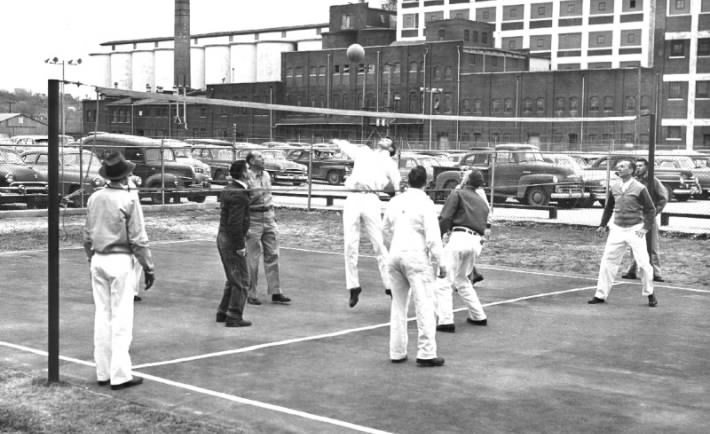
Volleyball has rapidly evolved over the past century. The sport started out as a relaxing recreational activity for adult men but it is now a fun and competitive sport for everyone to enjoy.




 VOLLEYBALL


